
Author Archives: Juliane Böhm

News for patients with platinum-resistant ovarian cancer

News for patients
with platinum-resistant ovarian cancer

The pharmaceutical company Eli Lilly recently received approval from the US Food and Drug Administration with a Breakthrough Therapy Designation for a new drug called sofetabart mipitecan was awarded. This designation is only awarded if an active substance shows initial indications that it could deliver significantly better results in a serious disease than previously available therapies.

What is Sofetabart mipitecan?

Sofetabart mipitecan is a so-called antibody-drug conjugate (ADC) that specifically targets the folic acid receptor alpha (FRα) on tumor cells and releases a chemotherapy substance there. This receptor is strongly present in many ovarian tumors, which should allow the drug to have a targeted effect.Previous results from early studies, which were presented at major cancer congresses such as ASCO 2025 and ESMO 2025, showed a tumor response in patients who had previously received standard therapies such as bevacizumab or mirvetuximab soravtansine. The data to date also indicate that side effects are manageable and that severe lung problems, nerve damage or severe eye damage rarely occurred.

What does the FDA designation mean?

The Breakthrough Therapy Designation is intended to accelerate the development process and enable earlier discussions with authorities. Although it is not a sure indication of approval, it does mean that the results to date are so promising that faster development and testing seems sensible.

Phase 3 study FRAmework-01 to start soon in Germany!

Based on these positive interim results, Lilly has initiated the phase 3 study called FRAmework-01 has been started. In this trial, sofetabart mipitecan is being investigated in patients with platinum-resistant ovarian cancer (PROC) as a single therapy patients with platinum-sensitive ovarian cancer (PSOC) in combination with bevacizumab.The start of the trial in Germany is planned for spring 2026. spring 2026 and offers patients the opportunity to participate in an ongoing Phase 3 trial, provided they meet the inclusion criteria (e.g. diagnosis of a platinum-sensitive or platinum-resistant tumor).

Sofetabart mipitecan is a promising drug that could be effective in difficult-to-treat, platinum-resistant ovarian cancer, especially in tumors that no longer respond to other treatments, and is therefore a potential new therapeutic option.

The new Phase 3 study FRAmework-01 offers the opportunity to participate in an international study in Germany before approval is granted at a later date. As soon as the study starts, you will find further information on our study portal!

Source: Press release from Lilly (the article is in English)

Expression XVIII (18)

NOGGO S30/ Expression XVIII (18)

INTERNATIONAL SURVEY ON THE IMPACT OF CRISES ON PATIENTS WITH GYNECOLOGICAL TUMORS

Anxiety is a central issue in cancer patients with gynecologic diseases and can be exacerbated by various crises, such as war, finances and pandemics. Although clinical cancer research is mainly focused on therapies, several studies emphasize the need to consider fear in communication between patients, physicians and medical staff. The results of this survey will be used to identify potential solutions to overcome conflicts and help patients communicate with healthcare professionals and their families about these issues. This is a global study being conducted for the first time and includes patients from all continents to gain a global perspective.


What is the aim of the survey?

The aim of this survey is to establish a relationship between recurring anxiety and other crises (wars, financial and family crises, environmental disasters and pandemics) and to bring the anxieties together in order to draw clinical conclusions and analyze the interplay and possible solutions to overcome these conflicts. The results will then be used to develop and provide specific information materials and offer better mental health counseling.


What is the survey process?

A total of 1000 patients will be surveyed internationally for the study. The survey is anonymous and the data will be collected using a questionnaire, which will be available both online and in paper form at the participating study centers.

The questionnaire comprises around 80 questions on fears of illness relapse, fears of crises, but also on media use, personal resilience and other relevant questions.

Are there any risks?

Expression 18 is a survey study and therefore has no participation risks.

Participation requirements

The survey is open to all patients over the age of 18 who have been diagnosed with gynecological cancer, including breast cancer, regardless of the stage of the disease and the treatments they have received.

Where can I take part in the survey?

Participation is now open online possible!

This page was updated on 27.01.2026

NIS CAROLIN

NIS Niraparib - NOGGO-ov45 - CAROLIN

For patients with platinum-sensitive ovarian cancer who have no contraindications to niraparib

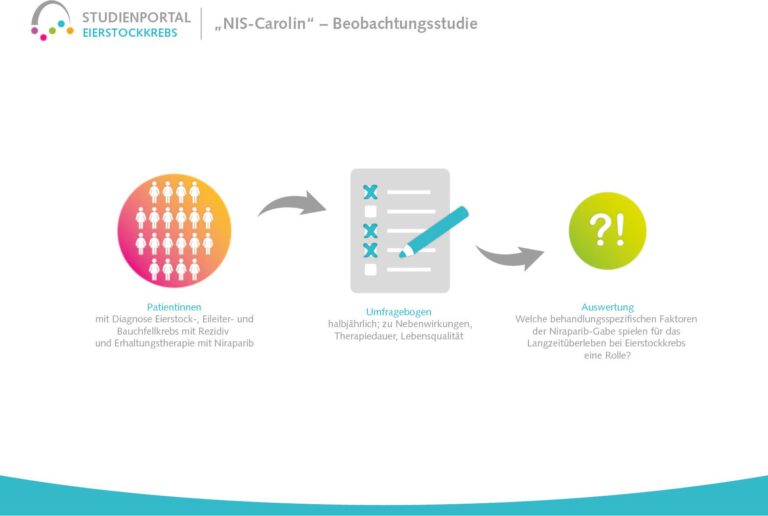
This non-interventional observational study aims to investigate the long-term treatment with niraparib in patients with platinum-sensitive ovarian cancer who have been diagnosed for the first time or have already suffered a relapse (recurrence) and to identify factors associated with long-term survival. Niraparib is a so-called PARP inhibitor that prolongs the effect of chemotherapy after its completion by suppressing the repair mechanisms in the cancer cells damaged by the chemotherapy. The damaged cells are then unable to regenerate and die.

What is the aim of the survey?

The aim is to find out which typical features/characteristics with regard to the disease, therapy and patients are associated with long-term survival. The study will also investigate which treatment-specific factors of niraparib administration (dose, side effects, duration of therapy, quality of life during therapy) correlate with long-term survival.

What is the procedure for the study?

This is an observational study in which the decision to treat with niraparib was made by the doctor and patient before the start of the study and the therapy is carried out according to the standard regimen. Patient data is collected at the beginning of the study and every six months thereafter, for up to eight years after study inclusion.

Are there any risks?

This is a purely observational study, i.e. the patients do not receive any additional medication or other treatment regimes. In this respect, the study participants are not exposed to any additional risks or side effects. However, treatment with niraparib, which is prescribed to patients with ovarian cancer after chemotherapy in the relapse situation, can have side effects, e.g. lead to a lack of blood platelets, a lack of certain white blood cells (neutrophil granulocytes), anemia, high blood pressure or fatique syndrome.

Participation requirements

Women aged 18 and over with ovarian, fallopian tube or peritoneal cancer who have been diagnosed for the first time or have relapsed (confirmed by histological findings) and who have achieved a tumor response with chemotherapy can take part in this study. Patients must be suitable for maintenance therapy with niraparib, i.e. they must have no contraindications and be able to take oral medication independently and reliably. Patients who are hypersensitive to the preparation, pregnant or breastfeeding may not take part in the study.

Where can I take part in the studies?

This study is supported by:

The research-based pharmaceutical company GLAXOSMITHKLINE is a partner in this study.

New study data from ESMO 2025 – Immunotherapy brings survival benefit in platinum-resistant ovarian cancer for the first time

New study data from ESMO 2025
Immunotherapy provides first survival benefit in
platinum-resistant ovarian cancer

A press release on the initial results of the ENGOT-ov65/KEYNOTE-B96 trial was published in May 2025, and the latest promising results were presented at the ESMO Congress in Berlin at the weekend. This international phase III trial investigated whether the combination of pembrolizumab (an immune checkpoint inhibitor) and paclitaxel (a chemotherapeutic agent), with or without bevacizumab (an angiogenesis inhibitor), can prolong the survival of patients with platinum-resistant ovarian cancer .

The results show: Although the gain in progression-free survival (PFS), i.e. the time until the disease continues to grow, was rather small at around 2 months, this difference was clinically relevant. However, the significant advantage in overall survival (OS) is decisive: patients whose tumors were PD-L1-positive (a marker for response to immunotherapy) lived an average of 18.2 months compared to 14.0 months in the comparison group that only received chemotherapy.

This means that for the first time in this difficult disease, where previous therapies are often only effective in the short term, a real survival benefit has been shown with immunotherapy – and in a patient group that has not been pre-selected.

The safety profile of the combination therapy was also acceptable overall, although grade 3 or higher side effects occurred in around two thirds of patients. Particularly noteworthy: the survival benefit was independent of whether or not bevacizumab was also given.

Experts see these data as a potential turning point in the treatment of platinum-resistant ovarian cancer. Until now, the effectiveness of immunotherapies in this type of cancer has been limited. This could now change, especially for patients with PD-L1-positive tumors.

Nevertheless, experts such as Dr. Rebecca Kristeleit (London) emphasize that the results should be interpreted with caution. The clinical benefit must be weighed against possible side effects and costs. It also remains to be seen whether the combination will be approved in the future or can only be recommended for certain subgroups.

Finally, future combination therapies were also discussed in Berlin: so-called antibody-drug conjugates (ADCs) could be used together with immunotherapies in the future and thus offer further hope for patients with this difficult form of tumor.

Source: ESMO Congress Report (the article is in English)

The most important ASCO results for ovarian cancer

The most important ASCO results 2025
for ovarian cancer

Yesterday, the 26th NOGGO Update on Gynecologic Oncology took place, where important studies on ovarian cancer from ASCO 2025 were presented. We were there and would like to share the most important findings:

First-line therapy – surgery

The TRUST study clearly showed that the success of primary surgery (immediately after diagnosis) depends crucially on the location and quality of the surgical center. Patients who underwent surgery immediately had significantly longer progression-free survival compared to patients who underwent interval surgery (surgery after chemotherapy pre-treatment). There was also a numerical advantage in overall survival. The decisive factor for this was whether no tumor remnants (R0 result) remained at the end, regardless of the time of surgery. The choice of a good center for first-line treatment is therefore decisive for the further course of the disease!

First-line therapy – immunotherapy

The FIRST study investigated whether the addition of the immunotherapeutic agent dostarlimab to first-line chemotherapy provides an advantage. The results showed only a moderate effect: progression-free survival (the time without progression of the disease) was extended by a median of 1.5 months, while overall survival remained unchanged. In addition, no specific patient group could be identified that benefited particularly strongly.

Recurrence therapy – immunomodulation

The ROSELLA trial showed real progress for patients with platinum-resistant ovarian cancer: the combination of relacorilant and the chemotherapeutic agent nab-paclitaxel significantly prolonged progression-free survival – and an interim analysis showed a clinically meaningful benefit in overall survival of around 4.5 months. The combination was well tolerated; no new safety signals emerged.

Conclusion for clinics and patients

Despite positive signals from TRUST and ROSELLA, the current guidelines remain unchanged. The importance of high-quality surgery has been further strengthened by the TRUST trial, while the ROSELLA trial is the first to show concrete progress in recurrence setting with the combination of relacorilant and chemotherapy. The addition of immunotherapy in the first line has so far only shown limited benefit.

The results provide an exciting outlook, but current guidelines continue to recommend established therapies. Further analysis and confirmation will be crucial to set new standards.