

Category Archives: Nicht kategorisiert

New study data from ESMO 2025 – Immunotherapy brings survival benefit in platinum-resistant ovarian cancer for the first time

New study data from ESMO 2025
Immunotherapy provides first survival benefit in
platinum-resistant ovarian cancer

A press release on the initial results of the ENGOT-ov65/KEYNOTE-B96 trial was published in May 2025, and the latest promising results were presented at the ESMO Congress in Berlin at the weekend. This international phase III trial investigated whether the combination of pembrolizumab (an immune checkpoint inhibitor) and paclitaxel (a chemotherapeutic agent), with or without bevacizumab (an angiogenesis inhibitor), can prolong the survival of patients with platinum-resistant ovarian cancer .

The results show: Although the gain in progression-free survival (PFS), i.e. the time until the disease continues to grow, was rather small at around 2 months, this difference was clinically relevant. However, the significant advantage in overall survival (OS) is decisive: patients whose tumors were PD-L1-positive (a marker for response to immunotherapy) lived an average of 18.2 months compared to 14.0 months in the comparison group that only received chemotherapy.

This means that for the first time in this difficult disease, where previous therapies are often only effective in the short term, a real survival benefit has been shown with immunotherapy – and in a patient group that has not been pre-selected.

The safety profile of the combination therapy was also acceptable overall, although grade 3 or higher side effects occurred in around two thirds of patients. Particularly noteworthy: the survival benefit was independent of whether or not bevacizumab was also given.

Experts see these data as a potential turning point in the treatment of platinum-resistant ovarian cancer. Until now, the effectiveness of immunotherapies in this type of cancer has been limited. This could now change, especially for patients with PD-L1-positive tumors.

Nevertheless, experts such as Dr. Rebecca Kristeleit (London) emphasize that the results should be interpreted with caution. The clinical benefit must be weighed against possible side effects and costs. It also remains to be seen whether the combination will be approved in the future or can only be recommended for certain subgroups.

Finally, future combination therapies were also discussed in Berlin: so-called antibody-drug conjugates (ADCs) could be used together with immunotherapies in the future and thus offer further hope for patients with this difficult form of tumor.

Source: ESMO Congress Report (the article is in English)
The most important ASCO results for ovarian cancer

The most important ASCO results 2025
for ovarian cancer

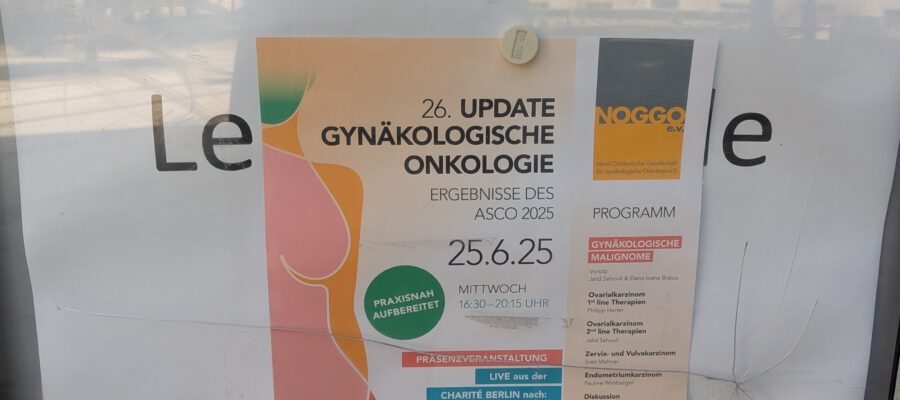
Yesterday, the 26th NOGGO Update on Gynecologic Oncology took place, where important studies on ovarian cancer from ASCO 2025 were presented. We were there and would like to share the most important findings:

First-line therapy – surgery

The TRUST study clearly showed that the success of primary surgery (immediately after diagnosis) depends crucially on the location and quality of the surgical center. Patients who underwent surgery immediately had significantly longer progression-free survival compared to patients who underwent interval surgery (surgery after chemotherapy pre-treatment). There was also a numerical advantage in overall survival. The decisive factor for this was whether no tumor remnants (R0 result) remained at the end, regardless of the time of surgery. The choice of a good center for first-line treatment is therefore decisive for the further course of the disease!

First-line therapy – immunotherapy

The FIRST study investigated whether the addition of the immunotherapeutic agent dostarlimab to first-line chemotherapy provides an advantage. The results showed only a moderate effect: progression-free survival (the time without progression of the disease) was extended by a median of 1.5 months, while overall survival remained unchanged. In addition, no specific patient group could be identified that benefited particularly strongly.

Recurrence therapy – immunomodulation

The ROSELLA trial showed real progress for patients with platinum-resistant ovarian cancer: the combination of relacorilant and the chemotherapeutic agent nab-paclitaxel significantly prolonged progression-free survival – and an interim analysis showed a clinically meaningful benefit in overall survival of around 4.5 months. The combination was well tolerated; no new safety signals emerged.

Conclusion for clinics and patients

Despite positive signals from TRUST and ROSELLA, the current guidelines remain unchanged. The importance of high-quality surgery has been further strengthened by the TRUST trial, while the ROSELLA trial is the first to show concrete progress in recurrence setting with the combination of relacorilant and chemotherapy. The addition of immunotherapy in the first line has so far only shown limited benefit.

The results provide an exciting outlook, but current guidelines continue to recommend established therapies. Further analysis and confirmation will be crucial to set new standards.