
About ovarian cancer
7,400 new cases per year

About ovarian cancer
With a new case rate (incidence) of 7,400 cases per year, ovarian cancer is one of the rarer forms of cancer in Germany. It develops from the superficial cells of the ovary.
As there are several cell types in the ovary from which cancer can develop, there are also different histological types of ovarian cancer. Cancer cells have the ability to divide uncontrollably and to grow beyond the natural boundaries of the organ. Many cells then form the tumor, which is also referred to as a tumor.
Only when the tumor is large enough does it cause discomfort for the patient (e.g. pain) and can be felt by the gynaecologist and visualized using various imaging techniques, such as ultrasound. Ovarian cancer cells can also reach other organs in the abdominal cavity and form metastases, e.g. on the peritoneum or lymph nodes. Ovarian cancer can return at a later stage even if the initial treatment was initially successful and unfortunately cause a so-called recurrence.
First things first
Don't rush things
Find experts
Get treatment at a center of excellence specializing in ovarian cancer (ESK)!
Don’t rush
Only in a few cases is surgery on the tumor necessary immediately. Discuss the treatment and any unanswered questions with your doctor in detail or even get a second opinion (e.g. from a specialist). Charité Berlin or KEM Essen).
Surgery
Surgery is the first and most important pillar of treatment for ovarian cancer. The aim is to achieve “macroscopic tumor freedom”, i.e. no visible tumor remnants should remain in the abdominal cavity. This complicated and very demanding procedure should only be performed by experts at the competence centers and be embedded in an overall gyne-oncological treatment concept.
Get support
Use your personal resources and get professional support, including from a psycho-oncologist.
Seek contact
The exchange and experiences of other affected people is often very valuable. Take advantage of the offers of the Self-help groups (e.g. Ovarian Cancer Germany e.V. or Women’s self-help after cancer).
Take the opportunity
Take the opportunity and find out about studies and participation in studies. This gives them access to the latest treatment options and allows them to be examined at shorter intervals. Studies are also considered a quality feature of the centers.
Already tested?
Knowledge of the BRCA and HRD biomarkers can be crucial, as it has an impact on the choice of therapy and can also provide important information for relatives. (Information about BRCAplus theme trip or BRCA Network)
What is ovarian cancer?
Clarification with Prof. Dr. Sehouli
You are currently viewing a placeholder content from YouTube. To access the actual content, click the button below. Please note that doing so will share data with third-party providers.
More InformationFacts about ovarian cancer
10 facts at a glance
… for ovarian cancer are unfortunately largely unknown. Although certain factors and life circumstances can increase the risk (e.g. age, early period, late menopause, genetic factors), they do not necessarily lead to the disease.
… or other safe preventive measures against ovarian cancer do not currently exist.
… is higher in women with ovarian cancer than in women who have not previously had a gynecological tumor.
… are only noticed relatively late and are also very unspecific. A feeling of fullness, flatulence, unclear abdominal pain or discomfort, an increase in abdominal girth, physical weakness, shortness of breath and pain can be the first signs.
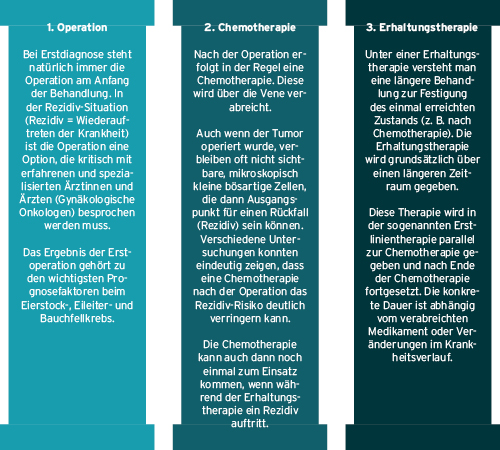
… of ovarian cancer is divided into various therapy pillars. These primarily include surgery and chemotherapy.
… almost always at the beginning of treatment when first diagnosed. The outcome of the initial operation is one of the most important prognostic factors for ovarian cancer.
… refers to cancer treatment with drugs that are intended to kill the tumor cells or prevent them from growing. This is the second pillar of treatment for ovarian cancer.
*Maintenance therapy: Maintenance therapy is an ongoing treatment that is used after completion of an initial therapy phase in order to maintain the treatment success achieved, prevent relapses or control the symptoms of a chronic illness.
… is the heart of the treatment. Only through trust, openness and transparency in joint discussions is it possible for the doctor to respond appropriately to your concerns, wishes and complaints.
Ovarian cancer therapy
The 3-pillar model
Further information on ovarian cancer
Knowledge is opportunity
Further information on initial therapy
Further information on recurrence therapy
Further information on living with ovarian cancer
News from science and practice
Information films on ovarian cancer
Thea – your therapy companion for ovarian cancer
Self-help groups and community
Always up to date
Stay informed
Fortunately, there have been new findings on ovarian, fallopian tube and peritoneal cancer in recent years, for example on FIGO stages (histology), HRD testing (genetics), maintenance therapy and long-term survival. You will find this news reflected in the wide range of information material from the German Ovarian Cancer Foundation, as well as in our News from science and practice section.


