Category Archives: Primary situation

NOGGO ov54 – SCOUT-1

NOGGO ov54 - Scout 1

Observational study to collect data from the everyday routine of patients with ovarian cancer undergoing initial therapy

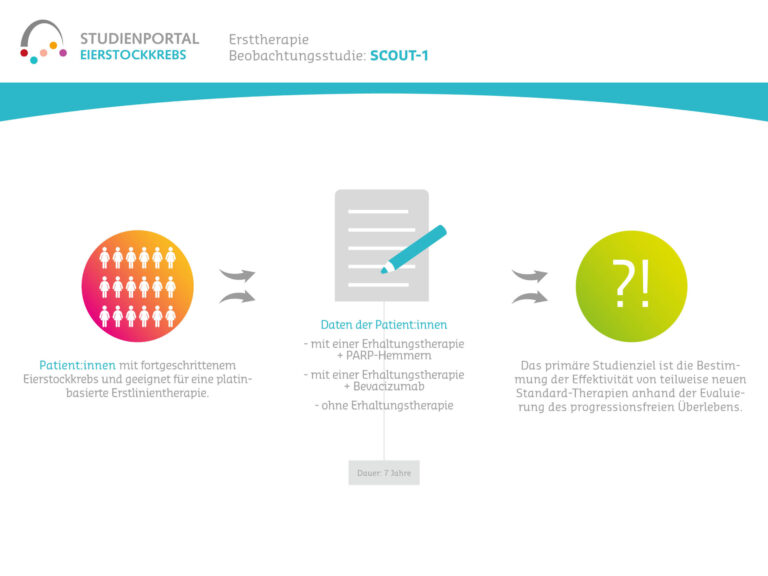
SCOUT-1 is a non-interventional study, a so-called observational study with the aim of collecting clinical and patient-reported data from the daily routine of patients with ovarian cancer. Eligible patients are those who are suitable for platinum-based first-line chemotherapy and for whom BRCA/HRD testing is planned. The observational study will collect data over a period of 7 years, but will not interfere with the course of treatment.

What is being investigated in this study?

The majority of patients with ovarian cancer are diagnosed at an advanced stage. Despite improved results from debulking surgery (removal of the tumor tissue) and a good response to platinum-based first-line chemotherapy, most patients with ovarian cancer suffer a recurrence within two years. (Source: S3 guideline Diagnostics, therapy and aftercare of malignant ovarian tumors, as of May 2022: Guideline program)

In the last two years, new treatment options have been researched, particularly in follow-up care, and expanded to include the concept of maintenance therapy. This has improved progression-free survival (i.e. the time between participation in a trial and disease progression). For example, the effectiveness of PARP inhibitors has been proven in advanced ovarian cancer and BRCA mutations. PARP inhibitors disrupt the DNA repair of cancer cells and thus activate the natural self-destruction program. A BRCA mutation is altered genetic material that can promote cancer. Studies have also shown that PARP inhibitors are effective in patients without a BRCA mutation.

Based on these new findings, a strong recommendation was made for the use of PARP inhibitors in first-line maintenance therapy. This extension of the approval of PARP inhibitors may influence diagnostic and therapeutic measures, follow-up care and patients’ perceptions and needs in everyday care. Most of these aspects will be observed in the study.

What is the aim of the study?

The primary objective of the study is to document data on disease progression and treatment of newly diagnosed advanced ovarian cancer. These data are collected during routine treatment. The aim is to determine the effectiveness of some new standard therapies by evaluating progression-free survival.

This observational study will also provide new insights into the treatment patterns and outcomes of patients with ovarian cancer under everyday conditions in Germany. The focus is on the effectiveness, expectations and needs of patients, molecular test procedures, selection criteria and tolerability of standard treatment sequences. Patient questionnaires, which patients fill out themselves on their state of health and quality of life, are intended to better understand the influence of the disease and treatment over the course of the disease.

What is the procedure for the study?

Patients are observed for up to seven years. During routine visits to the doctor, data on the patient’s medical history and current therapy is documented and some of this data is transferred to the study database. Therapy data collected in the years following the first-line therapy will also be transferred. Participation in the study does not result in any additional visits to the doctor. The quality of life and preference data are recorded electronically by the patients themselves using a questionnaire, so a smartphone, tablet or computer is required for participation.

Are there any risks?

In the SCOUT-1 observational study, there are no additional medical risks outside of routine care. There are confidentiality risks associated with any collection, storage, use and transmission of data. These risks cannot be completely ruled out and increase the more data can be linked together. The sponsor of the study does everything possible to protect the study data according to the state of the art.

Conditions of participation

Women aged 18 and over can take part in this study:

  • with newly diagnosed advanced ovarian cancer
  • suitable for platinum-based first-line therapy
  • with a completed or planned BRCA/HRD test

However, there are also other criteria that must be met in order to participate in the study. Interested patients should speak to the investigators at a study center, who can check whether this study is suitable for them.

Where can I take part in the study?

This study is supported by:

N-PLUS

NOGGO ov53/ ENGOT-ov62 - N-Plus

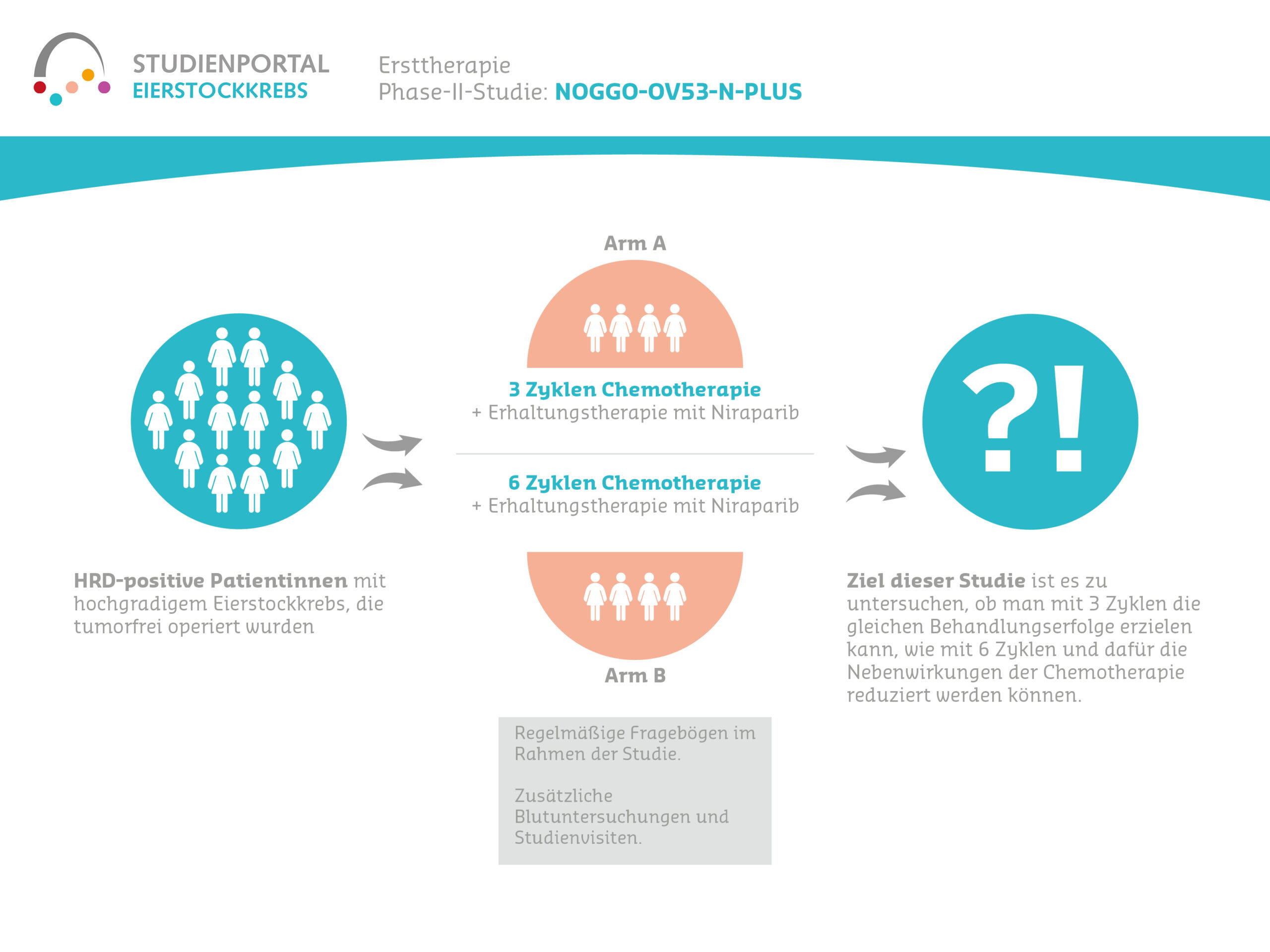
The world’s first study with the aim of reducing the number of chemotherapy cycles and thus the duration of chemotherapy in patients who have undergone tumor-free surgery. N-Plus is a study for HRD-positive patients undergoing initial therapy for advanced ovarian cancer.

N-PLUS is a randomized (random assignment to treatment arms), non-blinded (all parties know who gets what) phase II study of the non-inferiority of niraparib after 3 vs. 6 cycles of platinum-based chemotherapy in tumor-free patients with advanced, high-grade HRD positive ovarian cancer in first-line therapy.

What is being investigated in this study?

Until now, it has been standard practice for women to be treated with 6 cycles of chemotherapy after being diagnosed with cancer. Chemotherapy is usually associated with side effects that can be severe and can even lead to patients discontinuing treatment. There is evidence from past studies that fewer cycles of chemotherapy followed by treatment with a PARP inhibitor such as niraparib are no less effective than treatment with more cycles – but the chance of having fewer side effects is probably higher.

What is the aim of the study?

The aim of this study is to show that the efficacy and safety of three cycles of chemotherapy(carboplatin/paclitaxel) followed by maintenance therapy with niraparib in patients with high-grade ovarian cancer who have undergone macroscopic tumor-free surgery is not inferior to the effect of 6 cycles of chemotherapy plus subsequent maintenance therapy with niraparib. The question is therefore whether the same treatment success can be achieved with 3 cycles as with 6 cycles and whether the side effects can be reduced by the chemotherapy.

What is the procedure for the study?

Patients are randomly assigned (1:1) to one of the two treatment arms, the probability of receiving 3 cycles or 6 cycles of chemotherapy is the same (50:50). Patients complete two 15-minute questionnaires as part of this study, and there are also additional blood tests and study visits. After chemotherapy, niraparib is administered until the cancer worsens or for a maximum of 3 years. The tablets are taken daily.

Are there any risks?

You will be informed about possible risks and side effects associated with participation during an information session.

Participation requirements

Women aged 18 and over can take part in this study, with:

– HRD-positive, high-grade, advanced ovarian, fallopian tube or primary peritoneal carcinoma
– Stage III or IV
– Complete surgical resection

However, there are also other criteria that must be met in order to participate in the study. Interested patients should speak to the investigators at a study center, who can check whether this study is suitable for them.

Where can I take part in the study?

NIS CAROLIN

NIS Niraparib - NOGGO-ov45 - CAROLIN

For patients with platinum-sensitive ovarian cancer who have no contraindications to niraparib

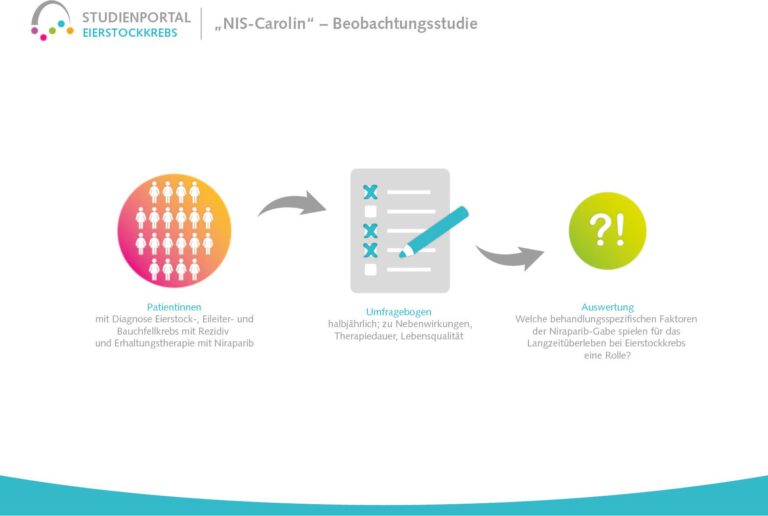
This non-interventional observational study aims to investigate the long-term treatment with niraparib in patients with platinum-sensitive ovarian cancer who have been diagnosed for the first time or have already suffered a relapse (recurrence) and to identify factors associated with long-term survival. Niraparib is a so-called PARP inhibitor that prolongs the effect of chemotherapy after its completion by suppressing the repair mechanisms in the cancer cells damaged by the chemotherapy. The damaged cells are then unable to regenerate and die.

What is the aim of the survey?

The aim is to find out which typical features/characteristics with regard to the disease, therapy and patients are associated with long-term survival. The study will also investigate which treatment-specific factors of niraparib administration (dose, side effects, duration of therapy, quality of life during therapy) correlate with long-term survival.

What is the procedure for the study?

This is an observational study in which the decision to treat with niraparib was made by the doctor and patient before the start of the study and the therapy is carried out according to the standard regimen. Patient data is collected at the beginning of the study and every six months thereafter, for up to eight years after study inclusion.

Are there any risks?

This is a purely observational study, i.e. the patients do not receive any additional medication or other treatment regimes. In this respect, the study participants are not exposed to any additional risks or side effects. However, treatment with niraparib, which is prescribed to patients with ovarian cancer after chemotherapy in the relapse situation, can have side effects, e.g. lead to a lack of blood platelets, a lack of certain white blood cells (neutrophil granulocytes), anemia, high blood pressure or fatique syndrome.

Participation requirements

Women aged 18 and over with ovarian, fallopian tube or peritoneal cancer who have been diagnosed for the first time or have relapsed (confirmed by histological findings) and who have achieved a tumor response with chemotherapy can take part in this study. Patients must be suitable for maintenance therapy with niraparib, i.e. they must have no contraindications and be able to take oral medication independently and reliably. Patients who are hypersensitive to the preparation, pregnant or breastfeeding may not take part in the study.

Where can I take part in the studies?
This study is supported by:

The research-based pharmaceutical company GLAXOSMITHKLINE is a partner in this study.

AGO-OVAR 28 / ENGOT-OV57

AGO-OVAR 28 / ENGOT-ov57

A randomized open-label phase III study evaluating niraparib alone versus the combination of niraparib and bevacizumab in patients receiving chemotherapy for newly diagnosed advanced ovarian cancer

What is the aim of the study?

Two large global studies in patients with newly diagnosed advanced ovarian, fallopian tube or primary peritoneal cancer have shown that the time to recurrence is prolonged when patients who have responded to previous platinum-containing chemotherapy receive maintenance treatment with a PARP inhibitor following chemotherapy. One study investigated the effect of niraparib alone; the other the effect of olaparib in combination with bevacizumab. This raises the question of whether maintenance therapy with a PARP inhibitor alone is sufficient or whether a combination with bevacizumab is necessary. The aim of this clinical trial is therefore to find out whether chemotherapy in combination with bevacizumab followed by maintenance therapy with bevacizumab and niraparib is more effective than chemotherapy followed by maintenance therapy with niraparib alone.

What is the procedure for the study?

This study is being conducted at around 200 trial sites worldwide; a total of around 970 patients are expected to take part.

If the patient decides to take part in the study, a declaration of consent must be signed. Various inclusion and exclusion criteria are used to check whether the patient is suitable for participation in the study.

If the patient is a suitable candidate for the study, she will start the first cycle of chemotherapy with carboplatin and paclitaxel as part of the study. At the same time, the patient’s existing tumor samples are tested for a BRCA mutation.

If the tumor sample is evaluable, a result is available before the 2nd cycle of chemotherapy and the patient is still suitable for participation, the patient will be assigned to one of the treatment arms listed below.

Treatment arm 1: The patient receives 5 further cycles of chemotherapy with paclitaxel and carboplatin and, after the end of chemotherapy, niraparib in the form of capsules to be taken daily for up to 3 years.

Treatment arm 2: The patient receives 5 further cycles of chemotherapy with paclitaxel and carboplatin as well as bevacizumab. After the end of chemotherapy, you will receive bevacizumab every 3 weeks for up to 1 year and niraparib as a capsule once a day for up to 3 years.

During chemotherapy and in the first year of maintenance therapy with niraparib (+/- bevacizumab), patients are called in for a study visit at the trial center every three weeks. Subsequently, these visits will take place every 12 weeks in the 2nd and 3rd year of maintenance therapy.

After completing treatment, patients are called in for a check-up and then for follow-up appointments every 3 months.

Are there any risks?

You will be informed about possible risks and side effects associated with participation during an information session.

Conditions of participation

This study is open to women aged 18 and over who:

  • are suffering from a newly diagnosed primary, advanced high grade epithelial ovarian, fallopian tube or primary peritoneal cancer with FIGO stage III/IV
  • have recently had tumor removal surgery or are scheduled to have tumor removal surgery during the course of their treatment
  • can provide paraffin-embedded tumor tissue
  • have an ECOG performance status (quality of life index of the Eastern Cooperative Oncology Group) of 0-1
  • with adequate organ and bone marrow function and normal blood pressure
  • are willing and able to participate in the study visits and understand all study-related procedures

However, there are also other criteria that must be met in order to participate in the study. Interested patients should speak to the investigators at a study center, who can check whether this study is suitable for them.

Last updated on 29.01.2025