Category Archives: Survey

Expression XVIII (18)

NOGGO S30/ Expression XVIII (18)

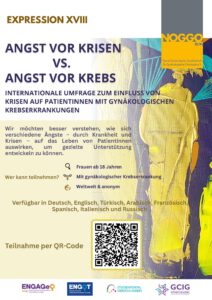
INTERNATIONAL SURVEY ON THE IMPACT OF CRISES ON PATIENTS WITH GYNECOLOGICAL TUMORS

Anxiety is a central issue in cancer patients with gynecologic diseases and can be exacerbated by various crises, such as war, finances and pandemics. Although clinical cancer research is mainly focused on therapies, several studies emphasize the need to consider fear in communication between patients, physicians and medical staff. The results of this survey will be used to identify potential solutions to overcome conflicts and help patients communicate with healthcare professionals and their families about these issues. This is a global study being conducted for the first time and includes patients from all continents to gain a global perspective.


What is the aim of the survey?

The aim of this survey is to establish a relationship between recurring anxiety and other crises (wars, financial and family crises, environmental disasters and pandemics) and to bring the anxieties together in order to draw clinical conclusions and analyze the interplay and possible solutions to overcome these conflicts. The results will then be used to develop and provide specific information materials and offer better mental health counseling.


What is the survey process?

A total of 1000 patients will be surveyed internationally for the study. The survey is anonymous and the data will be collected using a questionnaire, which will be available both online and in paper form at the participating study centers.

The questionnaire comprises around 80 questions on fears of illness relapse, fears of crises, but also on media use, personal resilience and other relevant questions.

Are there any risks?

Expression 18 is a survey study and therefore has no participation risks.
Participation requirements

The survey is open to all patients over the age of 18 who have been diagnosed with gynecological cancer, including breast cancer, regardless of the stage of the disease and the treatments they have received.

Where can I take part in the survey?

Participation is now open online possible!

This page was updated on 27.01.2026
EXPRESSION IX (9)

NOGGO S20 / ENGOTgyn4 - EXPRESSION IX (9)

Long-term survival with gynecological cancer / Langzeitüberlebende mit gynäkologischen Krebserrankungen

Based on the experience with Expression VI – Carolin meets HANNA, a survey focused on long-term survivors with ovarian cancer, we would like to conduct the same survey with slightly modified questions with survivors of other gynecologic cancers.

What is the aim of the survey?

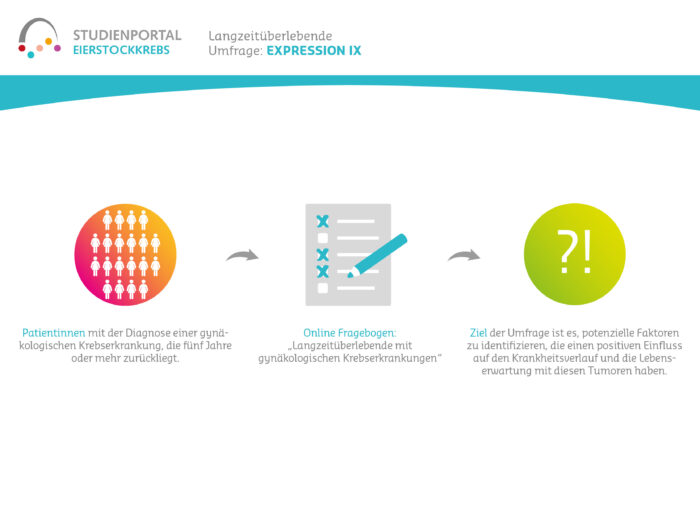
With the “Expression IX” survey, we want to expand the patient collective of long-term survivors and now want to include long-term survival with all gynecological tumors. As part of the study, we want to survey patients worldwide with cervical carcinoma, endometrial carcinoma and other rare gynecological tumors (e.g. gynecological sarcomas in the uterus or germline tumors) using an anonymized questionnaire and via the Internet. The aim of the survey is to identify potential factors that have a positive influence on the course of the disease and life expectancy with these tumors.

What is the survey process?

You will receive various questionnaires to complete. By completing the questionnaire or answering the questions, you agree to participate in the survey and that you are fully informed about this survey and understand the objectives of this survey. We have deliberately limited the number of questions to keep the effort for you as low as possible. To participate in this survey, we do not require any information such as your name, address or date of birth. The survey is anonymous. Completing the questionnaire will take approximately 1 hour of your time. Please return the completed questionnaire to the person who sent you the survey or send it to the address given in the questionnaire. It is also possible to participate via the link below.

Are there any risks?

No, it’s a survey.

Participation requirements

Women aged 18 and over can take part in this study:

  • with a diagnosis of gynecological cancer dating back five years or more

Where can I take part in the study?

You can take part in the survey via this link or via the participating centers.

NOGGO S19 – EXPRESSION VIII (8)

NOGGO S19 - EXPRESSION VIII (8)

For patients with a low-grade ovarian carcinoma (group A) or a borderline tumor of the ovary (group B – closed).

Serous ovarian carcinoma is classified into a well-differentiated (low-grade) tumor and a low-differentiated (high-grade) tumor. The low-grade tumor accounts for only about 10% of ovarian carcinomas and is associated with a better prognosis compared to the high-grade tumor. Despite the good prognosis, there is a great need for information for and about this patient group.

Expression-8-Ovar A

What is the aim of this survey?

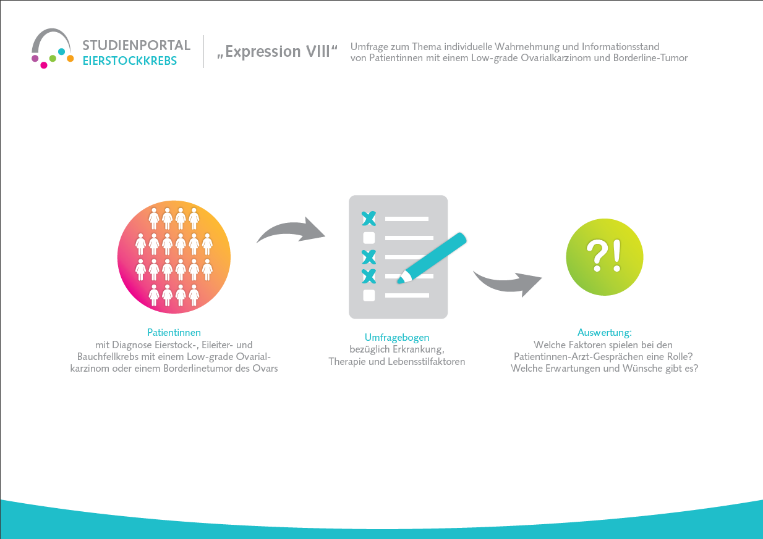
As part of the survey “EXPRESSION VIII – Individual perception and level of information of patients with low-grade ovarian cancer or a borderline tumor of the ovary”, we would like to learn from you in order to improve patient education about the disease and therapy and thus increase the level of information of patients.

How exactly does the survey work?

You will receive various paper questionnaires to complete. By completing the questionnaire or answering the questions, you agree to take part in the survey and confirm that you are fully informed about the survey and understand its objectives. We have deliberately limited the number of questions in order to keep the effort for you as low as possible. We do not require your name, address or date of birth to participate. The survey is anonymous. Completing the questionnaire will take about 20-30 minutes of your time. Please return the completed questionnaire to the person who gave you the survey or send it back to the address given in the questionnaire.

Are there any risks?

No, this is a survey.

Participation requirements

Women aged 18 and over can take part in this study.

    • Women aged 18 and over can take part in this study.
    • Patients with low-grade serous tubal, peritoneal or ovarian cancer.
    • Initial treatment, recurrences possible.

Group B for patients with a borderline tumor of the ovary is closed, as numerous patients have already taken part in the survey. We look forward to the upcoming study results!

Where can I participate in the study?

Patients can take part via the participating centers. It is not possible to answer the questions in this survey via the Internet.

EXPRESSION VI (6)

NOGGO S13 / ENGOT-ov40 - EXPRESSION VI (6)
CAROLIN MEETS HANNA

For patients with ovarian, fallopian tube and peritoneal cancer who were diagnosed at least 5 years ago

NEW: Instead of the previously required period of eight years after initial diagnosis, we would now like to invite all long-term survivors of at least five years after initial diagnosis to take part in this survey.

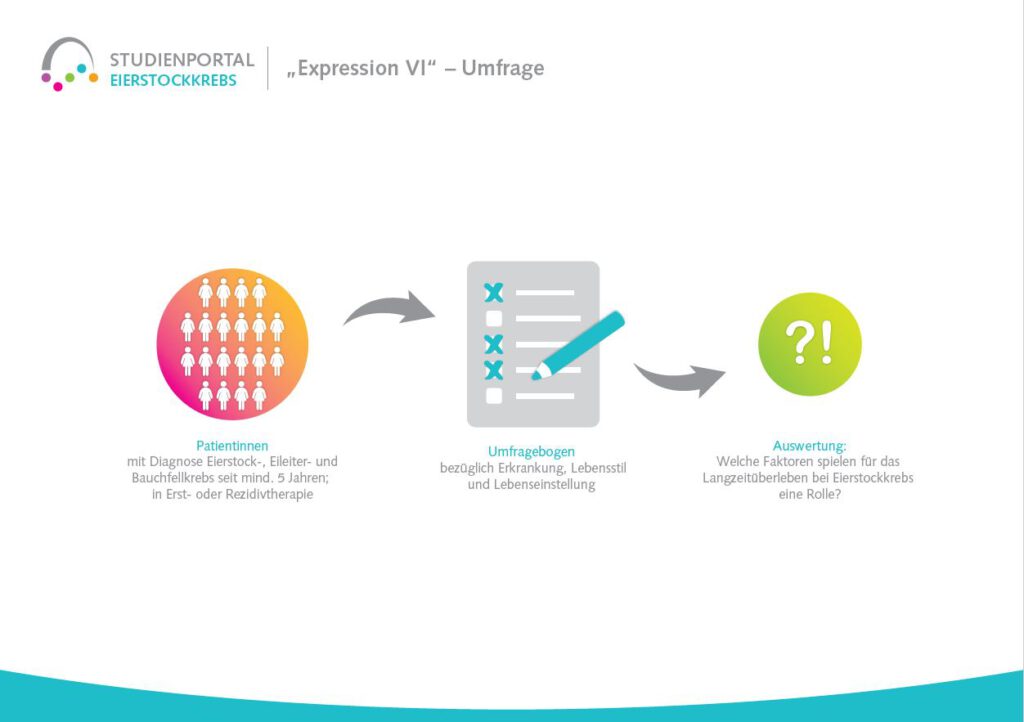
Ovarian, fallopian tube and peritoneal cancer is a very serious tumor disease. Many women often die from it in the first few years. You have been successfully fighting ovarian cancer for more than five years now. Unfortunately, most patients have a much worse course of the disease than you. Patients who were diagnosed more than 5 years ago are called “long-term survivors”. As very little research has been carried out on these patients to date, the survey sheds light on what makes this rare patient group special. So far, there is only speculation as to what the different courses of the disease might be due to.

What are the particularities of life and lifestyle that have made women live with ovarian cancer for so many years? For example, non-smoking, a balanced diet and immunological factors are discussed. The study examines lifestyle, living conditions, psychological factors and social conditions.

What is the aim of the survey?

We would like to learn from you as part of this survey “Expression VI – Long-term survival with ovarian cancer” – with the aim of giving you direct feedback and being able to make better recommendations to other patients regarding modifiable factors such as diet and exercise.

What is the survey procedure?

By completing the questionnaire or answering the questions, you agree to participate in the survey and that you are fully informed about this survey and understand the objectives of this survey. We have deliberately limited the number of questions in order to keep the effort for you as low as possible. To participate in this survey, we do not require any information such as your name, address or date of birth. The survey is anonymous. Filling out the questionnaire will take about 20-30 minutes of your time. Please return the completed questionnaire to the person who gave you the survey or send it to the address below.

Are there any risks?

No, it’s a survey.

Participation requirements

Women aged 18 and over can take part in this study:

  • Patients who were born at least were diagnosed with ovarian cancer at the age of 5
  • Initial treatment, recurrences possible

Where can I take part in the studies?

You can take part in the survey under this link.

EXPRESSION XX (20)

NOGGO S33/ Expression XX (20)

SURVEY AMONG PATIENTS WITH GYNECOLOGICAL TUMORS ON HOW TO DELIVER BAD NEWS

Breaking bad news is an essential part of everyday medical practice, especially in gynecologic oncology. Despite the frequency of these conversations, breaking bad news is a considerable challenge for many doctors.

Studies emphasize the need for communication training in order to strengthen the self-confidence of medical staff and reduce the fear of such conversations. To date, however, there have been few studies on this topic, especially in German-speaking countries, which record the perspective of patients when breaking bad news in gynecological oncology. To close this gap, the Expression 20 survey was planned.

What is the aim of the survey?

The aim of this survey is to record and analyze the perspective of female patients when delivering bad news. Differences between women with and without a migration background will be examined. It is assumed that female patients generally see a need for improvement when breaking bad news. In addition, research is to be conducted into whether women with a migration background feel less well informed compared to women without a migration background and whether they have a need for intercultural skills and services.

What is the survey process?

A total of 500 patients will be surveyed for the study. The survey is anonymous and the data will be collected using a questionnaire, which will be available in paper form at the participating study centers. The questionnaire is available in 4 languages – German, Turkish, Arabic and English.

The questionnaire is divided into 2 parts:

  1. Socio-demographic questions:
    15 questions about the person (age, educational status, partnership, mother tongue, place of birth) and the tumor disease
  2. Interview questions:
    46 Questions about a conversation in which bad news about the illness was communicated. The questions relate in particular to the patient’s condition and wishes during this conversation and the time after the conversation.

Are there any risks?

Expression 20 is a survey study and therefore has no participation risks.

Participation requirements

Women with gynecological-oncological tumor diseases including borderline tumors may participate in this survey. The minimum age is 18 years. Only women living in Germany are included.

Where can I take part in the survey?

The study is currently being conducted in Berlin at the Department of Gynecology at Charité’s Virchow Clinic and at Vivantes Klinikum am Urban.

Participation is now also possible online possible!

This study is supported by:

Page last updated on: 23.01.2026